City of Madrid unveils White Paper on Urban Air Mobility
POLIS member Madrid has taken a landmark step in urban mobility innovation with the unveiling of its White Paper on Urban Air Mobility, positioning the capital as a frontrunner among European cities in the field.
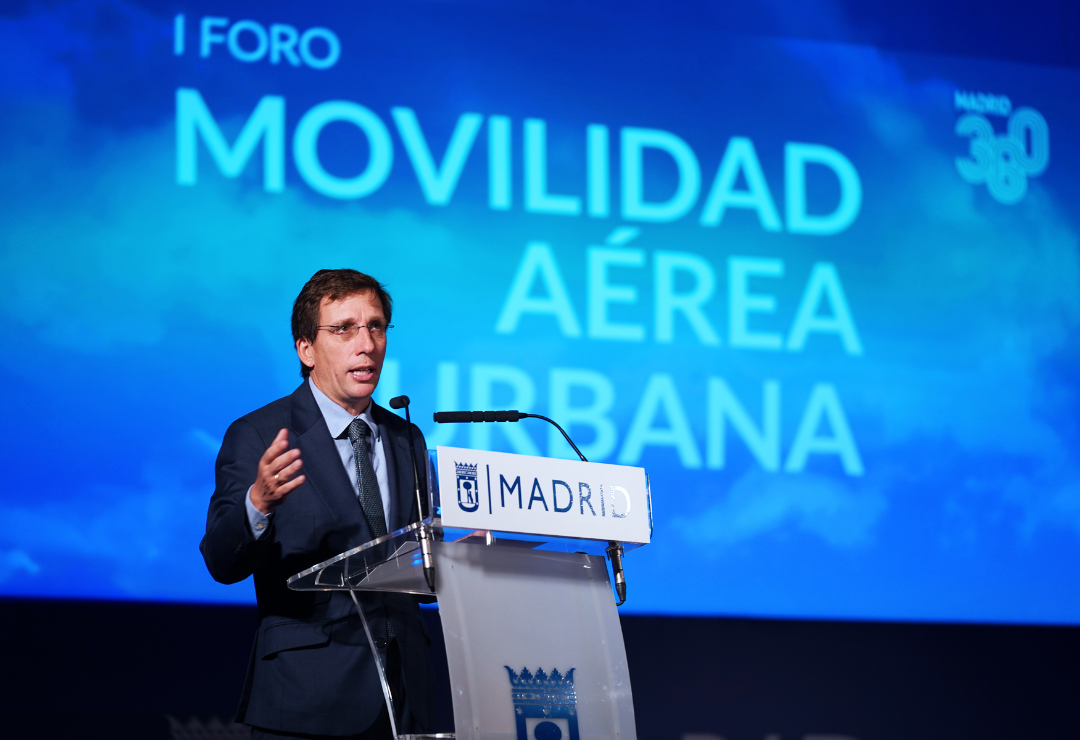
Last week, on 20 October 2025, Madrid held its first Urban Air Mobility Forum, where Mayor José Luis Martínez-Almeida announced that the city will adopt a dedicated regulatory framework for aerial mobility by the end of 2028.
“Madrid must lead and advance in all debates that promote better mobility and innovation, including urban air mobility,” said Almeida, describing the White Paper as “a fundamental milestone for the city”.
A roadmap in three phases
The White Paper sets out a phased roadmap for implementation, beginning with governance and regulation and progressing towards a fully integrated network of eVTOL (electric vertical take-off and landing) vehicles and aerial corridors:
- Short-term (2026-2028): Establish governance structures, align municipal and regional regulations, launch pilot projects and controlled trials, and run public awareness campaigns.
- Medium-term (2029-2031): Develop necessary infrastructure such as vertiports and drone pads, build technological systems, and begin limited deployment.
- Long-term (from 2032 onwards): Reach full regulatory maturity, expand aerial operations and corridor networks, and refine governance based on pilot results and sustainability criteria.
The roadmap is designed as a flexible framework that can evolve in response to changes in technology, regulation, and public acceptance.
Madrid's urban air mobility journey
Madrid first started its urban air mobility journey in September 2023, when it established the Commission on Urban Air Mobility. The Commission brings together around 80 members from public administrations, academia, technology centres, aerospace firms, and sector experts.
Its work was organised across six thematic groups, namely Regulation, Safety, Operations, Infrastructure, Environment & Citizens, and Economic Operators, whose findings form the basis of the White Paper.
The White Paper forms part of Madrid 360, the city’s flagship sustainability strategy. Under this plan, Madrid has already made significant progress in improving air quality and promoting sustainable transport. The new aerial mobility framework now adds a third dimension to this vision.
This achievement demonstrates how cities can take a proactive role in shaping the future of mobility. The White Paper sets a course for Madrid, while also providing a model for other European cities seeking to integrate urban air mobility into their transport systems.
Read Madrid's White Paper on Urban Air Mobility here (in Spanish).