
Bringing public transport information to the next level: Takeaways from the POLIS tutorial on GTFS
GTFS (General Transit Feed Specification) is a game-changer for public transport information. In the second module of the POLIS tutorial series on data standards and specifications in urban mobility, we explored GTFS together with POLIS member MobilityData.
The online Technical Tutorial was held on 4 December 2025, hosted by POLIS in partnership with MobilityData, as part of a new tutorial series on data standards and specifications in urban mobility. This session dived into the benefits and practical applications of GTFS, a widely used open standard for sharing transit information, that enables transit agencies to provide structured data on routes, stops, schedules, fares, and service alerts, making public transport easier to use and more accessible.
The tutorial featured insights from Isabelle de Robert, Regional Director Europe at Mobility Data, who illustrated the guiding principles and scope of GTFS, its components, and the latest extensions. Stephen Miller, Policy Lead at Transit App, presented the features of the Transit App for both passenger and transport systems. Lastly, Claudiu-Bogdan Minea, Founder, Software Developer, and Head Consultant at FlashWeb IT, shared practical applications of GTFS and GTFS-Realtime with the cases of Bucharest and Timișoara. Interactive Q&A sessions allowed participants to discuss policy and technical aspects with the experts.
POLIS members who participated gained insights into the two components of GTFS: Schedule (static data such as timetables and fares) and Realtime (live updates on vehicle positions, delays, and alerts). GTFS is a powerful tool that can be utilised across various trip planners, mobile apps, and other digital platforms, providing passengers with accurate and up-to-date information. With its open, community-driven governance, GTFS allows the data specification to evolve with public authority, policy and operational needs.
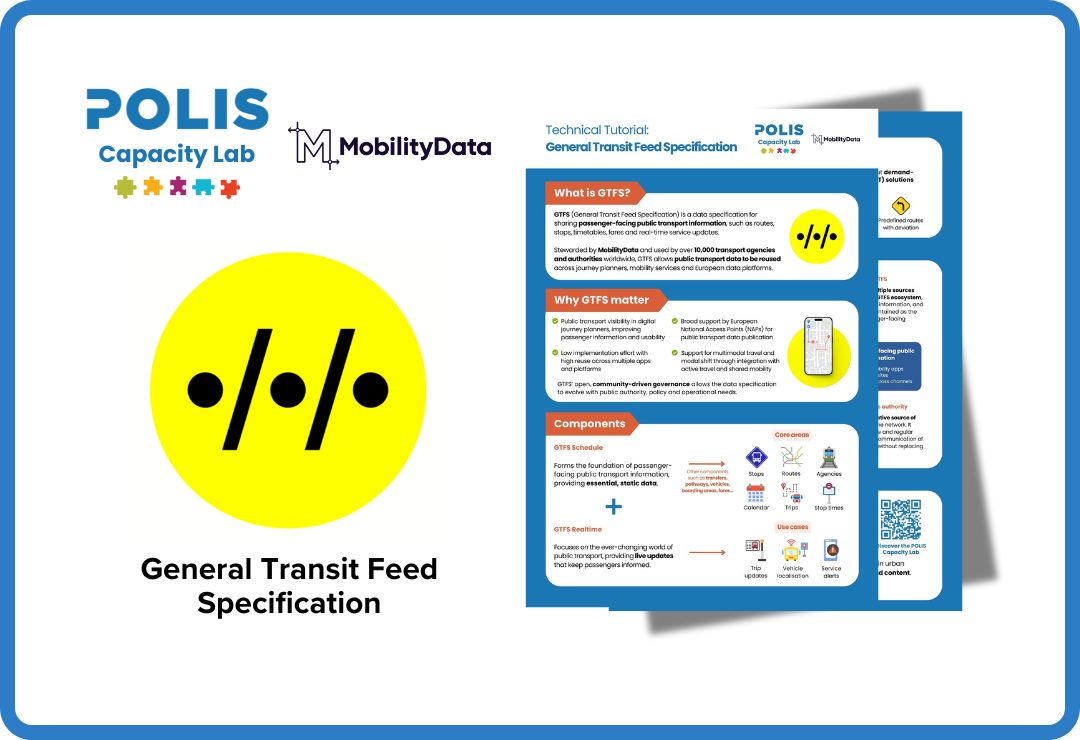
A factsheet summarising GTFS and its benefits is publicly available here.
POLIS members can access the recording and presentation in the Members Area here.
About the POLIS Capacity Lab
The POLIS Capacity Lab equips mobility practitioners, city officials, and regional planners with the knowledge, tools, and skills needed to implement innovative and sustainable urban mobility solutions. Through peer-to-peer learning, interactive workshops, and structured training, the Capacity Lab strengthens technical and strategic capabilities, accelerates the adoption of innovative solutions, and bridges the gap between policy and practice.
Tutorials are structured online sessions (1–2 hours) that guide participants in using specific tools, methods, or products to solve real urban mobility challenges. Interactive elements such as Q&A and demonstrations help participants immediately apply what they’ve learned. The POLIS tutorial series on data standards and specifications in urban mobility focuses on real-world applications and tangible benefits, helping POLIS member cities and regions understand, implement, and work with data standards. It also creates a space for dialogue with standard-setting bodies, ensuring the collective voice of local authorities plays a stronger role in shaping Europe’s digital mobility future.
To have full access to POLIS Capacity Lab activities and content, find out how you can become a POLIS member here.
- Related Members