All about exchanging static transport information with the POLIS tutorial on NeTEx
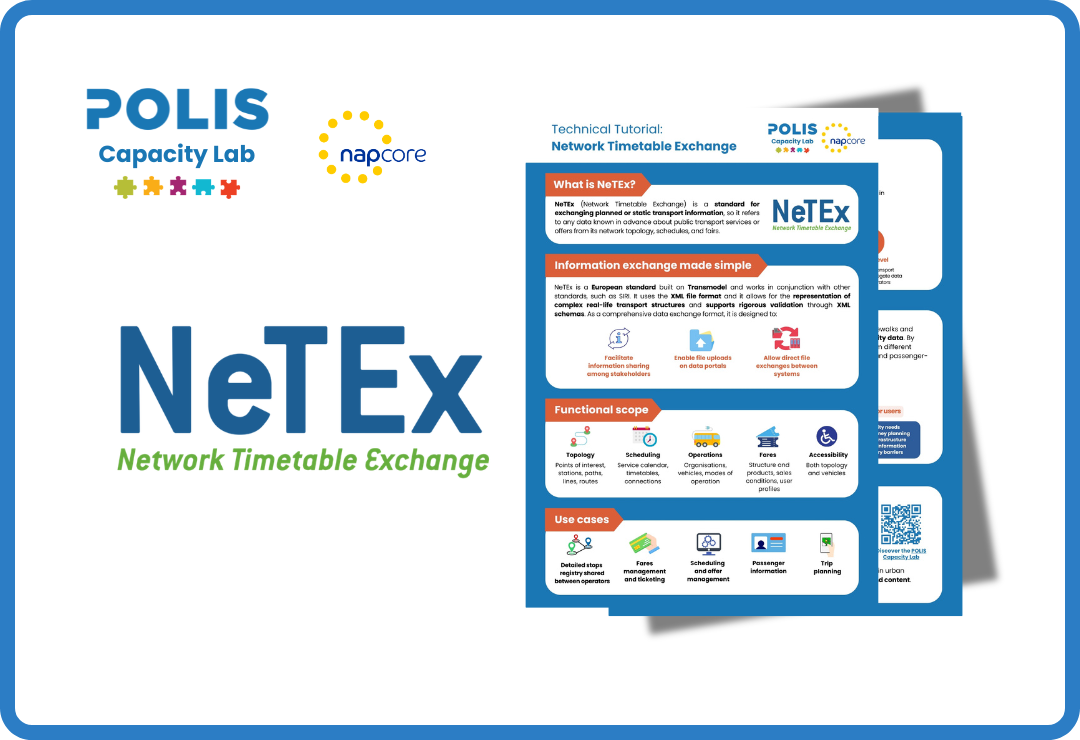
The fifth module of the POLIS tutorial series on data standards and specifications in urban mobility, held together with NAPCORE, was dedicated to NeTEx (Network Timetable Exchange), a European standard for exchanging planned or static transport information.
The online Technical Tutorial was held on 7 May 2026, hosted by POLIS in partnership with NAPCORE, as part of a new tutorial series on data standards and specifications in urban mobility. The session featured an in-depth look into the use cases and specifics of NeTEx, a standard that allows the exchange of static data on public transport, from passenger information to operational needs.
The tutorial featured insights from Tu-Tho Thai, NAPCORE, who introduced the context, as well as tools and resources for cities. Sylvaine Le Noxaïc, Lorient Agglomération, presented how the Lorient Agglomération used NeTEx to create an accessible journey-planning platform. Interactive Q&A sessions allowed participants to discuss policy and technical aspects.
This was a valuable opportunity for POLIS members to discuss the specifics and dive into the format's details, getting to know the many use cases of NeTEx. For cities and regions, it is a powerful and comprehensive standard to organise the data exchange between all their operators and relevant IT-based systems, to support their own passenger information systems, and to feed open data at all levels. The NeTEx field of application covers multimodal travel information and all static information about public transport.
A factsheet summarising NeTEx and its benefits is publicly available here.
POLIS members can access the recording and presentation in the Members Area here.
About the POLIS Capacity Lab
The POLIS Capacity Lab equips mobility practitioners, city officials, and regional planners with the knowledge, tools, and skills needed to implement innovative and sustainable urban mobility solutions. Through peer-to-peer learning, interactive workshops, and structured training, the Capacity Lab strengthens technical and strategic capabilities, accelerates the adoption of innovative solutions, and bridges the gap between policy and practice.
Tutorials are structured online sessions (1–2 hours) that guide participants in using specific tools, methods, or products to solve real urban mobility challenges. Interactive elements such as Q&A and demonstrations help participants immediately apply what they’ve learned. The POLIS tutorial series on data standards and specifications in urban mobility focuses on real-world applications and tangible benefits, helping POLIS member cities and regions understand, implement, and work with data standards. It also creates a space for dialogue with standard-setting bodies, ensuring the collective voice of local authorities plays a stronger role in shaping Europe’s digital mobility future.
To have full access to POLIS Capacity Lab activities and content, find out how you can become a POLIS member here.