Road safety coaching for local authorities
Municipalities have great responsibility when it comes to improve road safety. Kirsten De Mulder, Ine Herten, and Werner De Dobbeleer investigate how participating in a coaching programme allows local authorities to gain insight into the steps they can undertake to further develop their road safety policy in the short and longer term.
Together with local police, municipalities have an important responsibility to improve road safety within their territory. Since 2018, the VSV (Flemish Foundation for Traffic Knowledge) together with the Belgian Federation of Road Traffic Victims (OVK-SAVE) and the province of Antwerp have been assisting local authorities in drawing up road safety action plans.
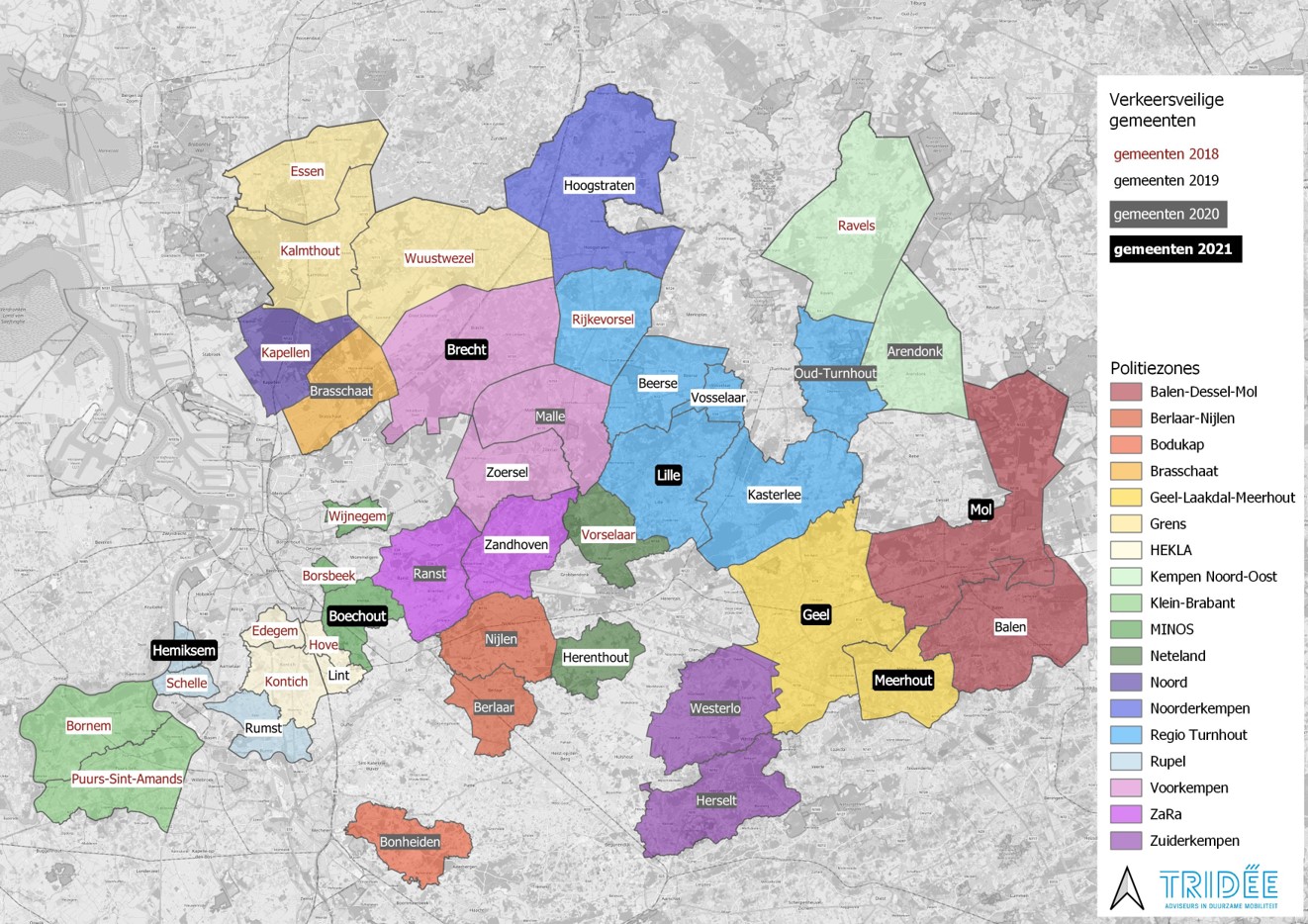
Overview of participating municipalities from 2018 to 2021 - Credits: TRIDÉE
Their coaching programme is the second step in a longer pathway starting with the signature of a “SAVE charter” and leading to the obtention of a “SAVE” label (awarded by OVK-SAVE) and a “Traffic safe municipality” label (awarded by the province of Antwerp). A total of 42 Antwerp municipalities have already participated in the programme between 2018 and 2021.
The way it works
The coaching programme is an intensive process in which local authorities learn to set up a high-quality road safety policy. Together with fellow municipalities (“peers”), the participants find out what a high-quality road safety policy involves, and they receive tailor-made advice on how to improve road safety in their territory. Throughout the coaching, they make a thorough analysis of their current road safety policy. The participants gain insight into current bottlenecks and learn how they can further develop their policy in the short and longer term and how they can achieve better results by aligning various measures.
The coaching programme starts with a self-evaluation, followed by setting objectives and drawing up a concrete plan of action. The tools that support the programme are useful not only for the participants but also for the coach and the partners. The initiative allows local authorities to learn from others and in turn give valuable input themselves. This ensures that the participants can take concrete steps, based on the experiences of similar municipalities (peers). The findings from the coaching programme are also of interest for VSV, OVK-SAVE and the province of Antwerp, as they can provide input for further action at a higher policy level.
Developing a Methodology
For this assignment, VSV called on a consulting agency, TRIDÉE. A methodology was developed, together with tools that support the participants during the programme. Candidates have to apply for participation and are selected according to criteria such as the number of crashes at local level. The number of participants per year is limited, but candidates that are not selected in a first round are still eligible for coaching in a next edition. The province of Antwerp has the ambition to have zero road victims in the entire territory.
Local authority representatives asked to cooperate in the self-evaluation and the consecutive coaching moments include the Mayor, the Councilor and local civil service officer(s) responsible for mobility, and the Chief traffic officer of the local police. At the request of the municipality, other relevant actors can be involved, such as representatives from schools, the cyclists' federation, and parents and seniors’ associations.
Self-evaluation as a first step
Various tools are used to support the coaching process. The self-evaluation checklist gives the municipality, the local police and the coach a general overview of all the ingredients for a high-quality local road safety policy. After completion, it provides insight into the current policy status at local level.

Example of the self-evaluation checklist after completion - Credits: VSV
The self-evaluation checklist is completed by the mayor, the councillors and civil servant(s) responsible for mobility and road safety, and the traffic police officer. This gives the participants a good idea of the topics they are already working on and those that require extra attention. During the on-site coaching moments, the self-evaluation results are a starting point for the group discussion and for determining what actions are needed to achieve the objectives. The topics are bundled into five categories:
- Policy & Organisation;
- Education & Communication;
- Engineering;
- Enforcement;
- Monitoring & Evaluation.
Scores are colours that indicate a specific level of performance, from red (no performance) to dark green (excellent performance):
- Orange = 'Ad hoc': sporadic measures, reactive, only when necessary (low performance)
- Yellow = 'Isolated': initiatives and information in some cases (limited performance)
- Light green = 'Systematically': implemented, good information available, improvement possible (good performance)
- Dark green = 'Integrated': implemented and systematically monitored, information is collected and used innovatively (excellent performance)
Developing a plan of action
The plan of action template builds on the self-evaluation. For each topic treated in the self-evaluation, it allows to formulate an action, indicating the responsible person(s) and the timing.
The tools are accessible online on a central platform with a protected area for each municipality and local police force. The platform provides additional information on road safety in general and practical “how to” tips on specific topics that local authorities – often small municipalities - struggle with.

Example of the plan of action template - Credits: VSV
Next steps
Every coaching process is evaluated and adjusted if necessary. Bottlenecks are discussed and, if needed, also linked back to the higher government. At present, VSV offers this coaching only in the province of Antwerp because of the specific cooperation, but its ambition is to offer the programme in the other Flemish provinces as well, in order to achieve the goal of zero road victims by 2050.
____________________
About Traffic Safe Municipality
The 'Traffic Safe Municipality' pathway consists of 3 steps, containing 10 elements:
-

The “Traffic Safe Municipality” pathway - Credits: Province of Antwerp
Signing of the SAVE Charter (OVK-SAVE). With their signature, the participants officially commit to improving road safety on their territory. This is a solemn moment(step 1 in the schedule).
- Internal kick-off meeting per municipality where they receive more information about the process. They get to know the partners and know what the commitment entails. The internal kick-off marks the start of step 2 in the schedule, the coaching programme leading to the plan of action. It allows the participants to get started with the self-evaluation.
- A telephone coaching moment in which the self-evaluation is discussed. The various stakeholders fill in their self-evaluation
- A joint kick-off meeting (half a day) during which all participating municipalities get to know each other and gain insight into how you can tackle traffic problems at local level. A former participant testifies to how they have experienced the process. The self-evaluations are discussed among the participants and they get a lot of inspiring examples that they can work with.
- A second telephone coaching moment takes place to prepare the on-site coaching and to develop the first elements for the plan of action.
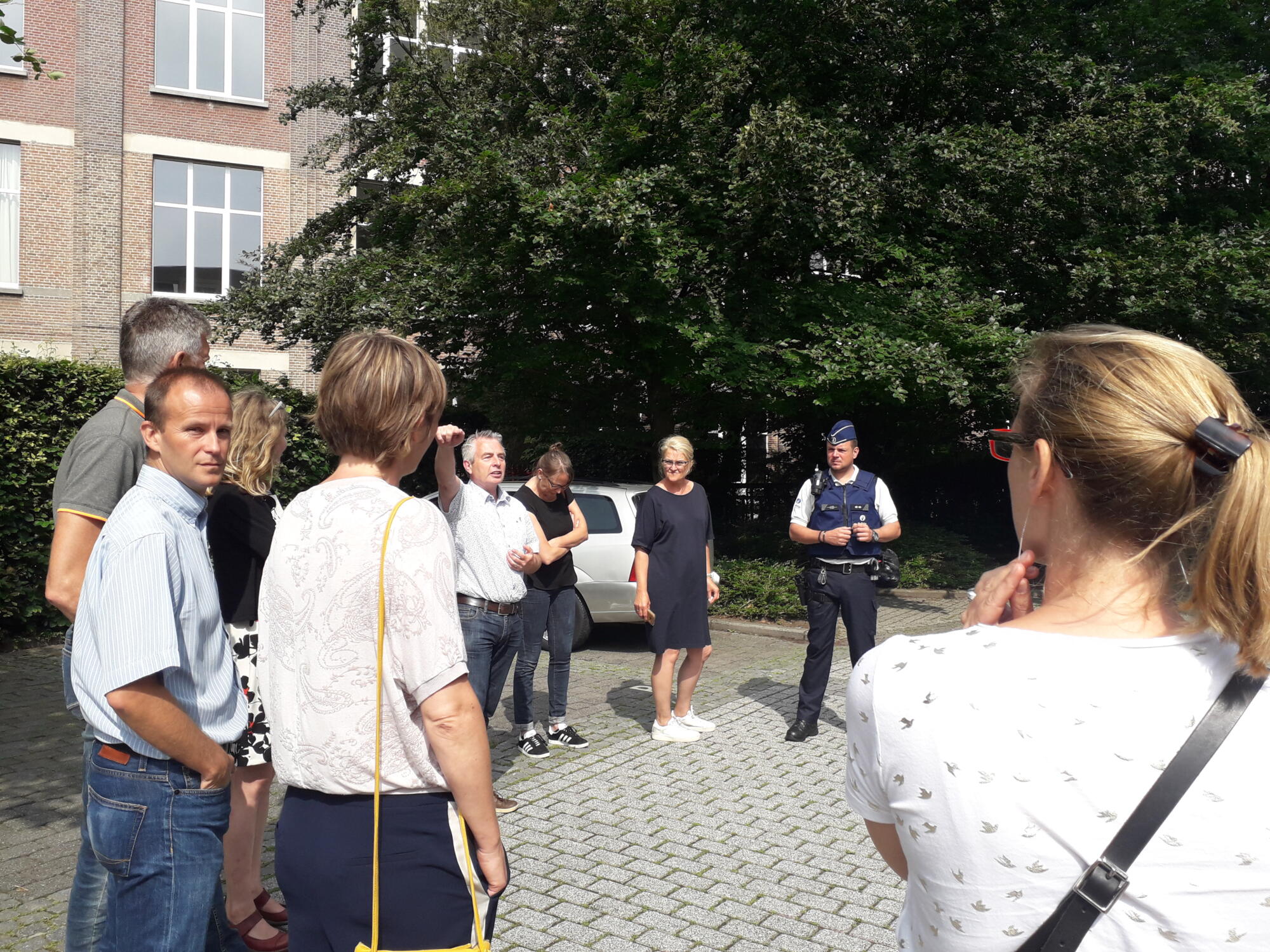
- The on-site coaching moment (half a day + maximum 2 extra half days) is a site visit to each municipality. The focus is on developing the plan of action, based on a number of concrete cases and with input from the coach, the partners and the peers. All participants are invited to join each other's on-site coaching moments. Expert advice is always combined with the experiences and insights of colleagues from other municipalities.
- A third telephone coaching moment focuses on the most important actions in the plan of action.
- The final meeting(half a day) focuses on best practice examples and points of attention. Each municipality presents one best practice example. This meeting concludes step 2 in the schedule.
- The municipalities continue with step 3 in which they implement the action plan with further support from OVK-SAVE and the province of Antwerp.
- The goal is to obtain a SAVE label and a 'Traffic Safe Municipality' label at the end of step 3.

____________________
About resources
- Dutch:
- For information about the coaching process for municipalities: Coaching Verkeersveiligheid voor gemeenten
- For getting to know the project ‘Traffic-safe municipality’ by the province of Antwerp: Verkeersveilige Gemeente
____________________
About the authors
Kirsten De Mulder, Ine Herten, and Werner De Dobbeleer are, respectively, Team Manager, Project Manager and Press Officer at the Flemish Foundation for Traffic Knowledge (VSV).
 Credits: VSV