
Is my bus very busy?
Madrilenians can now know in advance the occupancy level of their public buses thanks to Madrid Mobility 360, the innovative Mobility as a Service app launched by EMT last December 2020. EMT has deployed occupancy sensors in all its fleet and has built a 7-day forecasting model to allow multimodal routes with occupancy awareness and suggesting alternative low occupancy routes or later departures. Juan Corro Beseler tells us more.
The digitization of mobility, its multimodal integration and the availability of data and transport tickets are an imminent reality necessary for the achievement of the objectives set by the European Commission’s Sustainable and Smart Mobility Strategy published in December 2020 – and by national, regional, and local entities, too.

Credits: EMT Madrid
EMT Madrid, the Municipal Transport Company of Madrid, has already been working in this sense for quite some time – it has indeed resorted to technology as a tool to improve the user experience and to contribute to the efficiency of its services and the transport system as a whole. It has done so by promoting Mobility as a Service, as well as Open Data and technologies for the analysis and optimization of mobility.
Digitalise for a new urban mobility model

Madrid Mobility 360 - Credits: UITP
EMT Madrid is really concerned with the fact of improving the service given to passengers and investments in this sense only mean a better service to the population: the company has been very active in the use of Intelligent Transport Systems and Customer Information Systems, since it adopted its cutting-edge open data policy back in 2006, including the development of a MAAS App.
Under this approach, EMT has recently launched “Madrid Mobility 360”, a MaaS app evolving from previous attempts and hereby including a fully functional solution with booking and payments, as well as innovative functionalities to improve customers’ experience and safety.
The initiative is part of the new Sustainability Strategy of the City of Madrid – the so-called “Madrid360”, provides value to the citizens, the city and the different mobility operators involved, and offers development options and opportunities for public-private collaboration that will shape a new model of urban mobility in the city of Madrid.
Madrid Mobility 360 – how does it work?
“Madrid Mobility 360” serves as a multimodal route planner – indeed, it allows to get an almost instant “best possible” (but also “faster” or “cheapest”) transport combination for anyone who is in Madrid. All the mobility modes that exist in the city are taken into consideration, including free floating shared mobility services. What is more? That the app is the first one providing multimodal routes with occupancy awareness and suggesting alternative low-occupancy routes or later departures.
The route planner is also adapted to the COVID-19 travel decisions, as it offers information on bus occupancy, which, as far as EMT is aware of, is something quite unique worldwide. By means of a predictive model of occupancy that uses the validation data of the passenger's entrance and a descent count sensor, it is possible to determine an estimate of the number of users of a vehicle at a given moment.
This functionality, hitherto unprecedented in this type of application, is especially relevant to help in making mobility decisions in a more conscious and free way for the users, and positions Madrid at the forefront of digital mobility. In addition, this functionality is aligned with the objective of flattening the rush hour of public transport, resulting in a better user experience and a better public transport system within the frame of COVID-19 and post-COVID-19 mobility.
So… Is my bus very busy?
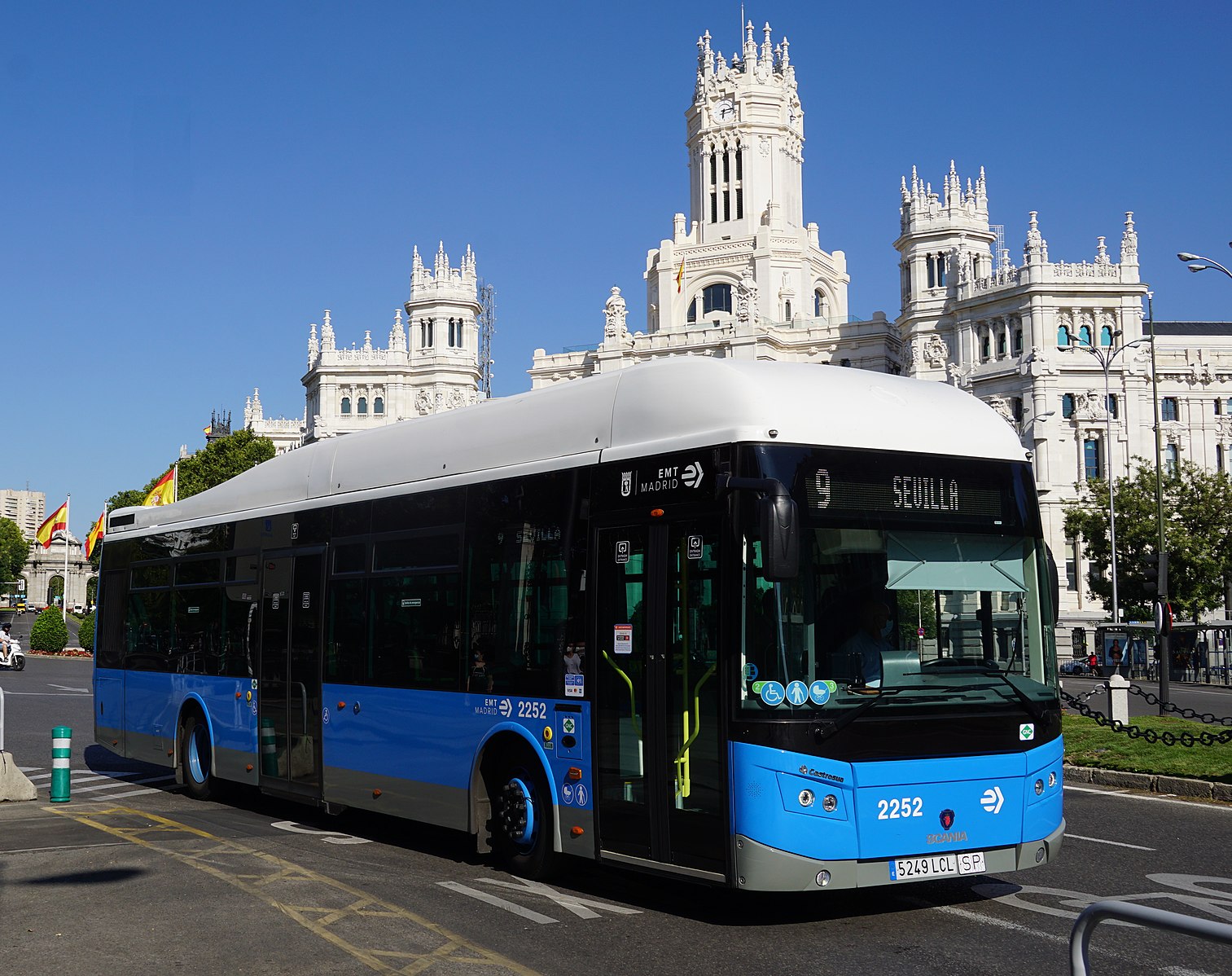
9 EMT Madrid in Alcalá Street, August 2020 - Credits: Autobusesbcn
The information on occupancy level is providing both when planning a bus route and when asking for bus info at the bus stop. Through the use of an intuitive colour code (green, yellow, orange, and red) and a message on the estimated level of attendance, the user obtains information on the occupancy of the bus in the section of the calculated route. The occupancy level, in sections of 25 %, already contemplates the capacity reductions currently established as a preventive measure against COVID-19.
This information is not merely descriptive; if the planned route includes a high occupancy section, the tool offers the user two alternative options: a second route with lower occupancy at the same time, or the same route with lower occupancy at a later time.
Madrid Mobility 360 also offers this information when the user selects a bus stop. For both the next bus and the one after, the application displays this information through an intuitive four-level occupancy icon. This way, the user can decide whether to take the next bus or, alternatively, wait for the next one.
Payment by QR code of the BiciMAD and bus service
The app also allows payments to purchase the single bus ticket, as well as BiciMAD and BiciMAD GO bike-sharing services. Once users select a certain bus stop within the app, they get all the information on the available bus lines stopping by and the QR Reader button activates (this, however, does require each user to be registered in the EMT digital identity and payments system called MPass).
Furthermore, it is also possible to access the services of BiciMAD Classic (station-based) and BiciMAD GO (free-floating) without leaving the app – in other words, through the same QR payment system based on the MPass account (with the QR code, the bike is unlocked).
Upcoming features
In April 2021, an update of “Madrid Mobility 360” has added the possibility of accessing EMT parking facilities by using the QR code available in the app or a system of vehicle’s plate recognition (including registration and payment via the MPass system). This function will allow to improve business rules to promote Park and Ride facilities.
What is ahead of the app is all yet to see, but this latest step sets already the tone for great improvements that will lead to a better digitalised transport system in one of the most vibrant and active cities of Europe.
____________________
About EMT Madrid as a POLIS Member
The Municipal Transport Company of Madrid (EMT Madrid) is the benchmark public integrated sustainable mobility operator that brings together Madrid’s urban buses, electric bike sharing system, parking facilities and electromobility infrastructure services. It is about to celebrate its 75 years of history serving the city and its citizens in solving their mobility challenges, also aligned today with the objectives set by the EU for the transformation of the European economy.
Madrid has been involved in the following EU projects: EVUE (Electric Vehicles in Urban Europe), MADEV (Madrid Electric Vehicle), CUTE, SIMBA II, STADIUM, INVOLVE, 3IBS, EBSF2, ENHANCED WISETRIP, FREVUE, ICT-EMISSIONS, NODES, STARS, CIVITAS ECCENTRIC, ASSURED, IKAAS, MOVEUS, COSMOS, INCLUSION and MARES.
____________________
About MRoute, MPay, MPass
The MaaS EMT offer aims to establish a simple and transparent model, in which everyone (operators, payment suppliers and users) can participate and in which everyone wins.
Two main platforms are being designed to respond to the mobility market needs – a highly dynamic and permanently in evolution ecosystem in which the agents are establishing new rules every day: a route planner (MRoute) and a payment platform (former MPay, current MPass).
While MPay was a concept oriented to electronic payment, its evolution MPass seeks to combine tickets or electronic transport tickets, simple or combined, within a multi-operator and multi-integrator interoperability platform. MPass includes electronic payment but also validation and combination of products.
____________________
About caring for the environment
Madrid Mobility 360 also informs about the estimation of CO2 emissions generated on a given journey, depending on the mobility choices, and also providing air quality information in real time (by the green icon on the screen). A working group is analysing the options to include NOx municipal protocols and information, too.
____________________
About the author
Juan Corro Beseler was Technology and Innovation Chief Officer at the EMT Madrid.
 Credits: Jhosef Anderson Cardich Palma via Unsplash