Organising dynamic data on public transport with the POLIS tutorial on SIRI
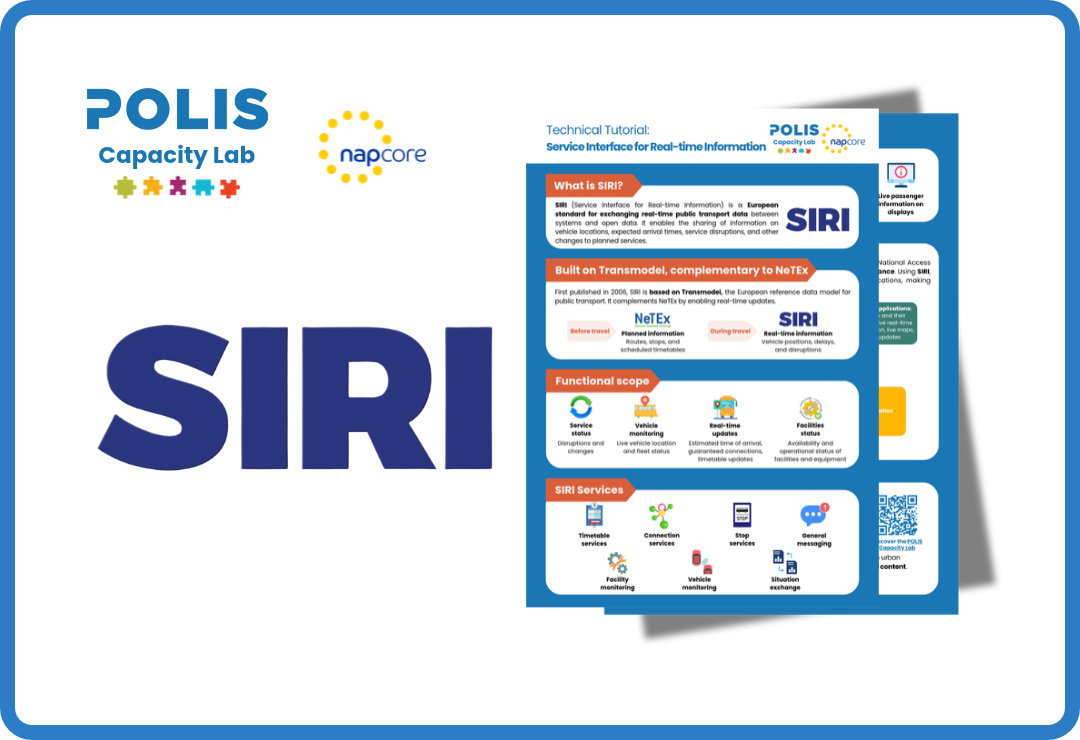
In partnership with NAPCORE, POLIS held the sixth tutorial series on data standards and specifications in urban mobility, on SIRI (Service Interface for Real-Time Information), a standard for exchanging dynamic data on public transport.
The online Technical Tutorial on 11 June 2026, hosted by POLIS and NAPCORE, explored the characteristics and practical applications of SIRI. SIRI is a standard listed in the MMTIS Delegated Regulation, and it enables the exchange of dynamic data across all types of public transport—from buses to shared bikes—for everything from passenger information to operational needs.
The tutorial featured contributions from NAPCORE, represented by Tu-Tho Thai. She illustrated the scope and services of SIRI, highlighting its value for cities and transport operators. The session also included a practical example from Siri von Krogh (Kolumbus), who explained how SIRI facilitates the sharing of vehicle positions and service updates with digital applications, as well as Kolumbus's experience with Entur.
POLIS members who attended learned about the tools and resources available for SIRI, its various use cases for cities and regions, and gained insights from a real-life example. For cities and regions, SIRI serves as a powerful and comprehensive standard for organising data exchange among all operators and relevant IT-based systems. This supports the development of real-time passenger information systems with richer data and promotes open data at all levels.
A factsheet summarising SIRI and its benefits is publicly available here.
POLIS members can access the recording and presentation in the Members Area here.
About the POLIS Capacity Lab
The POLIS Capacity Lab equips mobility practitioners, city officials, and regional planners with the knowledge, tools, and skills needed to implement innovative and sustainable urban mobility solutions. Through peer-to-peer learning, interactive workshops, and structured training, the Capacity Lab strengthens technical and strategic capabilities, accelerates the adoption of innovative solutions, and bridges the gap between policy and practice.
Tutorials are structured online sessions (1–2 hours) that guide participants in using specific tools, methods, or products to solve real urban mobility challenges. Interactive elements such as Q&A and demonstrations help participants immediately apply what they’ve learned. The POLIS tutorial series on data standards and specifications in urban mobility focuses on real-world applications and tangible benefits, helping POLIS member cities and regions understand, implement, and work with data standards. It also creates a space for dialogue with standard-setting bodies, ensuring the collective voice of local authorities plays a stronger role in shaping Europe’s digital mobility future.
To have full access to POLIS Capacity Lab activities and content, find out how you can become a POLIS member here.